

Product definition#
The calibration pipeline is a DPPS subsystem ensuring the best possible instrument accuracy and precision under all kinds of observation conditions. Its task is the production of calibration coefficients at DL0-DL3 data levels and for Category B & C data. Towards that goal, calibration pipeline analyses physics, monitoring and service data of the CTAO instruments, as well as external to CTAO meteorological data.
Functional decomposition#
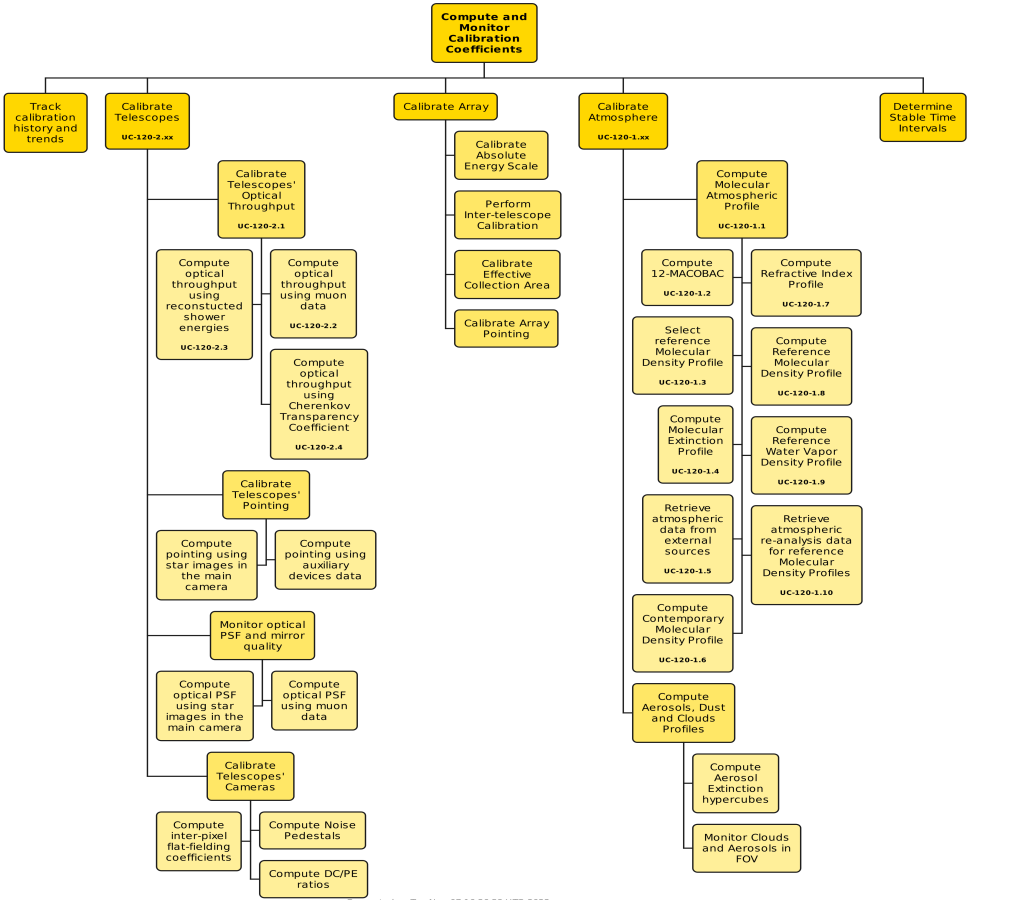
Atmospheric calibrations#
Atmosphere is the medium where γ-rays interact and Cherenkov radiation is produced and propagates through. A continuous monitoring and calibration of the state of the atmosphere is required in CTAO. The atmospheric calibration is split into molecular atmosphere calibration and aerosols / clouds calibration. The split is based on the sources of the calibration data: for the molecular atmosphere calibration is based on meteorological data while aerosols / clouds calibration is based mostly on data coming from CTAO monitoring devices (e.g. LIDAR, FRAM) and made available to DPPS through ACADA.
Molecular atmosphere calibration#
The modeling of the molecular component of the atmosphere affects both the shower development and the Cherenkov light transmission. The purpose of the calibration pipeline is to provide the best possible instrumental accuracy and precision under all kinds of observation conditions. In the context of molecular atmosphere calibration, this is translated into the selection / production and storage of atmospheric profiles for showers simulation and the selection / production and storage of Molecular Extinction Profiles. The calibration pipeline will provide two categories of data. Category-B will be provided the next day, after an observation night, while category-C will be of the highest quality and should be provided within a time period of two to four weeks. For category-C it currently uses the ERA-5 datasets of ECMWF. ERA-5 provides hourly estimates on 37 pressure level (from 1000hPa to 1hPa, roughly corresponding to 45km a.s.l.) with a geographical resolution of \(0.25^{\circ}\times0.25^{\circ}\). It is an early reanalysis data with a latency of 5 days, publicly available via European Union Copernicus service. The data is free but the creation of an account is required for data retrieval. For category-B, calibration pipeline uses the GDAS dataset ds083.2, available via the Research Data Archive. Similarly, the data is free but the creation of an account is required for data retrieval. ds083.2 provides estimates in 6 hours interval, up to ~26 km a.s.l. with a geographical resolution of \(1^{\circ}\times1^{\circ}\). The data become publicly available in near real time, so they can be used for “next day” calibration.
Please find below a mind map of the molecular atmosphere calibration usecases. The colour code depicts the status of the implementation.


Aerosols/clouds calibration#
Array calibration#
Array calibration refers to optical throughput / timing calibration method based on a given parameter, enabling both inter- (i.e. between telescopes of the same type) and cross-telescope (i.e. between telescopes of different types) calibration. The parameters used for calibration are the image size, the reconstructed energy and the event time. The optical throughput calibration relies on the principle that all (same type) telescopes triggered by the same air shower should reconstruct the same energy (image size) allowing relative calibration both for same and different telescope types. In the case of image size, only showers with impact points approximately equidistant from the telescopes in a pair can be used, ensuring a fair comparison of the recorded signals. Image size is a direct probe of the optical throughput of the telescope but it can’t be used for the cross calibration of different telescope types. The reconstructed energy allows for cross calibration, however it is based on energy reconstruction models trained with the non-corrected telescope optical throughputs. The algorithm for the optical throughput calibration is described in Mitchell, A.M.W. et al., “Cross Calibration of Telescope Optical Throughput Efficiencies using Reconstructed Shower Energies for the Cherenkov Telescope Array”, Astroparticle Physics 75 (2016), pp. 1–7. The timing calibration is relies on the fact that telescopes of any type triggered by the same shower should reconstruct the same event time.
Telescope calibration#
Optical throughput calibration via muon rings#
Muons rings is the main method of optical throughput calibration.

Camera calibration#

Command line tools#
The command line tools of calibration pipeline are based on ctapipe tools. A tool can be used by typing its name and providing as argument a configuration file in yaml format:
name_of_the_tool -c configuration_file.yaml
The tools currently provided are:
calibpipe-create-molecular-density-profile: Produces a contemporary molecular density profile.
calibpipe-select-reference-atmospheric-model: Selects the closest reference atmospheric model (molecular density profile and Rayleigh extinction profile) for the current observation.
calibpipe-calculate-macobac: Calculates the average \(CO_{2}\) background concentration for the previous 12 months.
calibpipe-calculate-camcalib-coefficients: Calculates the camera calibration coefficients.
calibpipe-produce-camcalib-test-data: Produces test data for camera calibration unit and integration tests.
calibpipe-create-molecular-atmospheric-model: Creates an atmospheric model (molecular atmosphere profiles and Rayleigh extinction profile).
calibpipe-upload-observatory-data: Uploads observatory data to the database.
calibpipe-upload-atmospheric-model-data: Uploads reference atmospheric model data to the database.
calibpipe-init-db: Initializes the CalibPipe database and creates required tables.
Example configuration files can be find here.